
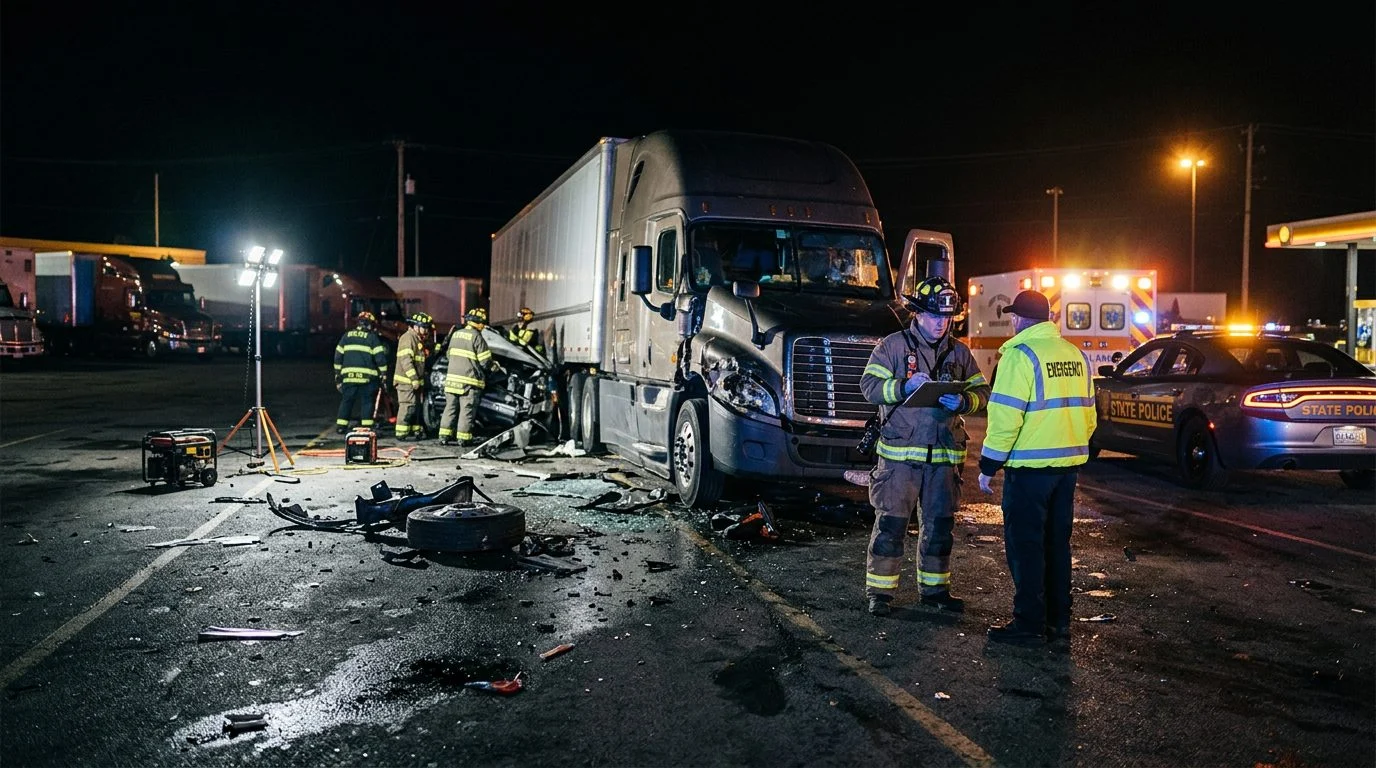
Truck crash claims | Serving families across West Virginia
When a Truck Crash Hurts Someone You Love, You Don't Have to Sort Out the Claim Alone
Big Bubba Injury Law represents injured family members and families in wrongful death cases after serious truck and commercial vehicle crashes across West Virginia. We focus on the legal steps so your family can focus on recovery.
Published October 27, 2026
An injured person who cannot make decisions still has a claim after a truck crash in West Virginia. This guide covers filing a truck crash claim for an incapacitated family member, what it can cover, the deadlines, and the evidence that matters. Big Bubba Injury Law serves injury victims across West Virginia, including Charleston, Huntington, Morgantown, Wheeling, Martinsburg, Parkersburg, Beckley, Clarksburg, Fairmont and Weirton.
Who Can Bring a Claim When the Injured Person Cannot Act for Themselves
- It may not cover legal claims or money, so read what it actually authorizes.
- Check the scope before you sign anything.
Being a spouse, parent, or adult child does not automatically let you sign a claim or accept a settlement. Confirm your authority early.
West Virginia law limits contact in the first weeks after an injury. For twenty days from the date of a personal injury, while the injured person is a hospital inpatient or is partially or totally unable to do his or her usual trade, profession or occupation, no one may negotiate or try to negotiate a settlement of the injury claim, obtain or try to obtain a partial or general release of liability, or obtain or try to obtain a written or oral statement for use in negotiating a settlement or getting a release. A person acting for the injured person may still take a statement at the injured person’s express request. A person who may be liable may still make an advance payment, and any sum paid during those twenty days counts as full credit against damages finally determined to be due (W. Va. Code § 55-7-11a). If a settlement, release or statement is obtained in breach of that twenty-day rule, the injured person may disavow it at any time within one hundred eighty days from the date of the injury. To do so, the injured person signs a written statement of disavowal and forwards a copy to the person who broke the rule. The settlement, release or statement then may not be admitted in evidence for any purpose in any court or other proceeding relating to the injury, if any consideration paid for the settlement or release is repaid or returned to the person who paid it.
You do not need every legal paper in hand to start. A free case review can help sort out which path fits your family member’s situation.
Not sure what your next step is?
Talk it through with Big Bubba — the first case review is free, confidential, and carries no obligation.

What a Truck Crash Claim Can Cover for an Incapacitated Person
A truck crash claim can seek compensation for the injured person’s losses. These often include:
- Past and future medical care and hospital bills
- Rehabilitation and therapy
- Home care or attendant care
- Lost income and reduced ability to earn
- Pain, suffering, and loss of enjoyment of life
Traumatic brain injury and spinal cord injury can require care for years. Families should document long-term needs from the start, because those needs shape the claim.
Some commercial truck cases have a limit on noneconomic damages, which cover pain and suffering. The section applies only to causes of action arising after July 1, 2024 (W. Va. Code § 55-7-32).
How Filing a Truck Crash Claim for an Incapacitated Family Member Works
Filing usually moves through five stages, and the timing varies with each case. The steps below follow a typical path.
- Gather the basics. Collect the crash report, photos, the truck company’s name, and the driver’s name.
- Document medical care. Keep records of diagnoses, treatment, rehabilitation, and the doctors’ outlook for recovery.
- Confirm legal authority. Identify the guardian, conservator, or agent, and who will sign documents.
- Ask for records to be kept. Send written requests to the carrier to keep driver logs, inspection reports, and vehicle data.
- Present the claim, then file suit if needed. A demand package goes to the insurers. If the claim does not resolve, a lawsuit may follow, and discovery lets each side exchange records and testimony.
Timelines depend on how serious the injuries are, whether the injured person has reached maximum medical improvement (the point where the condition is stable), and how many parties are involved. The firm can review the crash details and the authority question together.
Deadlines: How Long You Have to Bring a Claim in West Virginia
Most West Virginia personal injury claims must be brought within two years after the right to sue begins (W. Va. Code § 55-2-12).
- Personal injury: generally two years from when the right to sue accrued (W. Va. Code § 55-2-12).
- Injury claim after death: if the injured person dies before filing, and the claim was not barred by the statute of limitations at the time of death, the personal representative may bring the claim within the same period that would have applied had the person lived (W. Va. Code § 55-7-8a).
A coma or brain injury does not by itself extend the filing deadline, though the law provides limited exceptions, such as when the person was an infant or legally insane when the right to sue arose. For minors or people who were legally insane when the claim arose, the extended period in subsection (b) of W. Va. Code § 55-2-15 applies to personal actions other than sexual assault or abuse actions, and in no case may the action be brought after 20 years from the time the right accrues. Write down the crash date, the hospital admission, and the date the authority papers were signed.
Truck-Specific Evidence and Who May Share Liability
More than one party can share responsibility in a truck crash.
Key evidence often includes:
- Driver logs. Records of duty status show driving hours. Carriers must keep them for at least six months, and no driver or carrier may make a false report about them (49 C.F.R. § 395.8).
- If an alcohol test is not given within two hours, the employer must record why. After eight hours, it must stop trying. Drug testing has a 32-hour window (49 C.F.R. § 382.303).
- Electronic data. Many trucks record speed, braking, and other events. Ask in writing for this data to be kept, because it may not be saved without a request.
- Citations and court records. Keep any tickets and related court papers.
Under W. Va. Code § 55-7-13a, recovery in a personal injury, property damage, or wrongful death action is based on comparative fault, and each person’s liability is allocated in direct proportion to that person’s percentage of fault. Each party’s share of fault is set as a percentage, and recovery is allocated by those percentages (W. Va. Code § 55-7-13a).
When the Injured Family Member Has Died: Wrongful Death Claims
When a truck crash causes death, a court-appointed personal representative brings the wrongful death claim for the family.
The comparative fault statute allocates liability among plaintiffs, defendants and nonparties who proximately caused the damages, in direct proportion to each person’s percentage of fault (W. Va. Code § 55-7-13a).
- Sorrow, mental anguish, and solace, such as companionship and guidance
- Lost income and lost services the person would have provided
- Medical and hospital costs tied to the injury
- Reasonable funeral expenses
If the person was injured before dying, a survival claim for those injuries may also proceed (W. Va. Code § 55-7-8). Families often need both claims reviewed together.
Not sure what your next step is?
Talk it through with Big Bubba — the first case review is free, confidential, and carries no obligation.

Questions Families Ask Before Filing
Can I start a claim if my family member is awake but cannot understand the paperwork?
It depends on the person’s capacity and the documents available. Review the authority question early.
Do I need a guardian before a claim can start?
Not always.
Will the claim go to court?
Many claims resolve before trial. Some need a lawsuit, and timing depends on the facts.
What is the deadline?
Most West Virginia personal injury claims must be brought within two years (W. Va. Code § 55-2-12). Wrongful death claims generally run two years from the death (W. Va. Code § 55-7-6).
What should I keep?
Keep the crash report, photos, medical records, and letters from insurers. Write down dates as they happen.
Your family member may be recovering while you carry this decision. Tell Big Bubba Injury Law what happened, and request a free case review to talk through your next steps.