
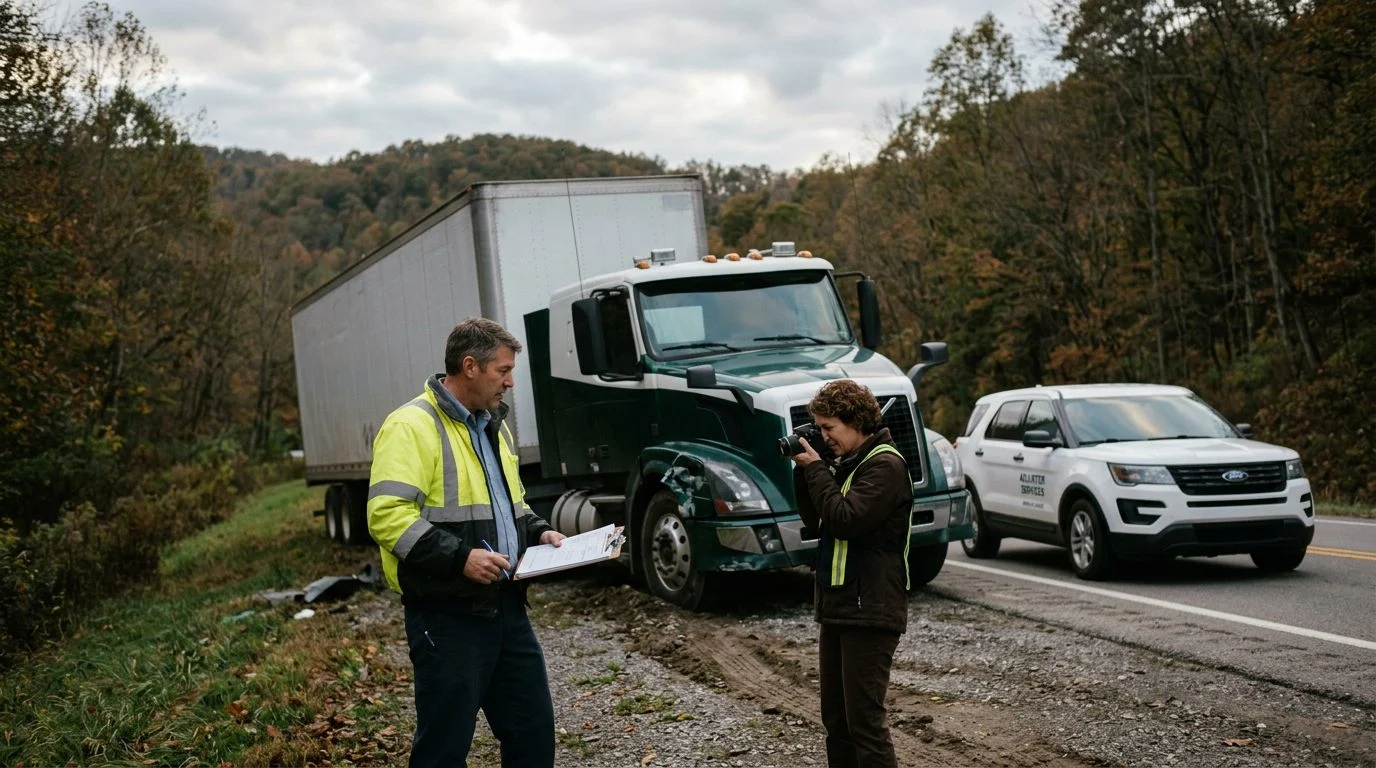
West Virginia Injury Claims
A Trucking Company Adjuster Called After Your Crash? Talk to Us First.
Insurance adjusters work for the insurer, not for you. Big Bubba Injury Law represents people hurt in car and commercial truck crashes across West Virginia, and we serve injury victims from Charleston to Weirton.
Published November 1, 2026
If a trucking company’s adjuster called you after a crash in West Virginia, you do not have to answer everything on that first call. The adjuster works for the company or its insurer. You can ask for time before you give details. This guide explains who is calling, what they may ask, and what to gather first.
Why a Trucking Company May Call You So Soon After a Crash
A call from a trucking company is usually from an adjuster working for the company or its insurer. An adjuster investigates and evaluates claims for that company. Their job is to learn what happened and to limit what the company pays. That goal differs from yours, even when the call sounds friendly.
Early calls are common in truck crashes. Getting one does not mean you did anything wrong. The company often starts its review quickly, while the scene, the truck, and the records are still fresh.
Federal rules set minimum insurance levels for many commercial trucks. Those levels can rise with the kind of cargo carried. 49 C.F.R. § 387.9 sets out the figures.
If a trucking company's adjuster called you after your crash and you're unsure what to say, you don't have to face that alone; the firm can talk it through with you. Talk it through with Big Bubba — the first case review is free, confidential, and carries no obligation.

What an Adjuster May Ask You in the First Call
An adjuster will usually ask for your contact details and the basic facts of the crash. Expect questions about the date, time, and location. They may ask where each vehicle was before and after impact, and what you saw or heard.
They may also ask about your injuries, your symptoms, and any doctor visits. Some calls ask whether you have talked to anyone else about the crash. The call may end with a request to confirm your insurance details or set a follow-up call.
Some questions are routine. Others can lock in details before you have reviewed them. You can answer what you know and say plainly when you need to check something.
Why You May Want to Pause Before Giving a Recorded Statement
You can ask for time before giving a recorded statement. West Virginia law also limits some early settlement contact after an injury.
For 20 days after a personal injury, no one may negotiate a settlement with you, seek a release, or get a statement for a settlement. This applies while you are an inpatient or partly or totally unable to do your usual work. W. Va. Code § 55-7-11a
Under W. Va. Code § 55-7-11a, a settlement, release of liability, or statement entered into, obtained, or made in violation of that section may be disavowed by the injured person at any time within one hundred eighty days from the date of the personal injury, and the settlement, release, or statement then may not be admissible in evidence for any purpose in any court or other proceeding relating to the personal injury if any consideration paid is repaid or returned to the person who paid it when the disavowal copy is forwarded. You do this by written statement sent to the person who violated the section. Whether this applies depends on your own situation.
A recorded statement can be used later in the claim, so early words matter. Your injuries may still be developing. Ask for the adjuster’s name, company, and claim number. Then set a later time to speak. Short, accurate answers with a clear reason you need time are often safer than guessing.
Information to Gather Before Any Call
Gather the crash facts, the truck details, and the police report number before you speak with the company again. Start with the date, time, and location. Write down the road names, cross streets, or landmarks nearby.
Next, record what the truck shows. Note the company name, the truck number, and any USDOT Number on the cab or door.
Keep the police report number and the names of any officers or witnesses. Save photos of both vehicles, the scene, and visible damage. Write a dated list of your symptoms, treatment visits, and missed work. A written timeline helps you answer later questions accurately.
Statements That Can Affect Your Claim Without You Meaning Them To
Early statements can affect your claim, even when you meant nothing wrong. Guessing is the most common problem. If you were unsure of speed, distance, or who had the right of way, say so. A guess can be repeated later as a fact.
Under W. Va. Code § 55-7-13a, recovery in an action for personal injury, property damage, or wrongful death is predicated on principles of comparative fault, and liability is allocated to each person in direct proportion to that person’s percentage of fault.
Describing injuries as minor is another risk. Symptoms such as headaches, back pain, or dizziness can appear days later. Tell the adjuster you are still being evaluated.
Do not agree to a summary the adjuster wrote until you have read every line. Do not sign a release or accept an early payment before you understand what it covers.
Why a Commercial Truck Crash Can Involve More Than the Driver
A commercial truck crash can involve the driver, the employer, the truck owner, and the insurer. Under West Virginia law, an employer defendant includes the owner of a commercial motor vehicle, the employer of its driver, and any entity with legal control over the vehicle or driver. W. Va. Code § 55-7-32
W. Va. Code § 55-7-32 caps noneconomic damages that each person injured or killed can recover against an employer defendant at $5 million per occurrence in crashes involving the operation of a commercial motor vehicle that requires a commercial driver’s license, but not passenger carriers, school buses, or other vehicles primarily engaged in transporting passengers. The cap is adjusted for inflation starting January 1, 2026, and applies only to claims arising after July 1, 2024. The cap has conditions and exceptions, including driving beyond hours-of-service limits. Federal hours-of-service rules limit how long commercial drivers may drive and require breaks.
A single adjuster call may not address every party. Police reports document crash facts, and they can be reviewed as part of a claim.
We serve clients in all 55 West Virginia counties, including Charleston, Huntington, Morgantown, Wheeling, Martinsburg, Parkersburg, Beckley, Clarksburg, Fairmont, and Weirton. We handle car accidents, truck accidents, commercial vehicle accidents, catastrophic injuries, traumatic brain injury, spinal cord injury, and wrongful death.
Not sure what your next step is?
Talk it through with Big Bubba — the first case review is free, confidential, and carries no obligation.
Talking Through Your Next Step After the Trucking Company Calls
If you are unsure what you said or what to do next, a free case review can help you sort out the call. A free case review is confidential and comes with no obligation to continue. It gives you a chance to explain the call, the crash, and your injuries in your own words.
If an insurer’s handling of your claim concerns you, West Virginia has a complaint route. The Office of the Insurance Commissioner accepts administrative complaints from third-party claimants against a person for an alleged unfair claims settlement practice.
Under W. Va. Code § 33-11-4a, a third-party claimant may not bring a private action for an unfair claims settlement practice. The sole remedy is an administrative complaint with the Commissioner, filed as soon as practicable and no later than one year after the actual or implied discovery of the practice. That complaint is separate from your injury claim.
Bring the adjuster’s name, the claim number, the police report number, and any notes you made.
What if the adjuster keeps calling or stops responding?
Keep a written record of every call, email, and message. West Virginia’s insurance regulator takes complaints about insurer conduct. File an administrative complaint no later than one year following the actual or implied discovery of the alleged unfair claims settlement practice.
How long do I have to file a wrongful death claim?
A wrongful death action generally must be brought within two years after the death. The personal representative of the estate brings it. W. Va. Code § 55-7-6 sets this rule, subject to other provisions of state law.
If a trucking company’s adjuster called you after your crash and you’re unsure what to say next, you don’t have to face it alone. Request your free case review with the firm.