
West Virginia Truck and Car Crash Cases
Fatal Truck Crash Evidence: What Proves Negligence in West Virginia
Families often ask what proof shows that a driver or company was at fault. Here is how that evidence is gathered, who tends to hold it, and why each piece matters.
Published October 21, 2026
Fatal truck crash negligence evidence usually comes from many sources that point the same way. This page explains the main kinds of proof, who tends to hold them, and why each one matters. Families in West Virginia often start this research for someone they love. We serve injury victims and families across the state, including Charleston, Huntington, and Morgantown.
What evidence is needed to prove negligence in a fatal car or commercial truck crash?
Proof usually shows three things. The at-fault party owed a duty of care, broke that duty, and that break caused the death. Records from the scene, the vehicles, the driver and carrier, and the medical files each help show one or more of those points.
No single record settles fault. Investigators usually build a timeline from several sources. When the records agree, the timeline is easier to test. When they conflict, the gaps become part of the dispute.
Commercial truck cases often involve more record types than car crashes. Federal trucking rules require carriers, except a private motor carrier of passengers (nonbusiness), to require each driver used by the motor carrier to record the driver’s duty status for each 24-hour period. Each piece of fatal truck crash negligence evidence adds detail a passenger car case may not have. Some trucking records must be kept only for set periods. Acting early helps make sure they are still there when needed.
If a fatal truck crash has left your family with hard questions, you don't have to sort out the records alone, and the firm can talk with you about them. Talk it through with Big Bubba — the first case review is free, confidential, and carries no obligation.

How do the four elements of negligence apply to a fatal crash?
Every injury claim raises questions about who was responsible and what harm resulted.
A trucking company can also share responsibility for how it runs its trucks.
Speeding, distraction, and driving while exhausted are common examples. Phone records, driver logs, and witness accounts can help show a breach.
Causation. Causation connects the breach to the death. Investigators often work out speed, following distance, and the order of events. This shows how the crash unfolded.
Damages. Under West Virginia law, a responsible party can be liable in an action for damages when a wrongful act causes death. W. Va. Code § 55-7-6
What does scene and vehicle evidence show after a fatal truck crash?
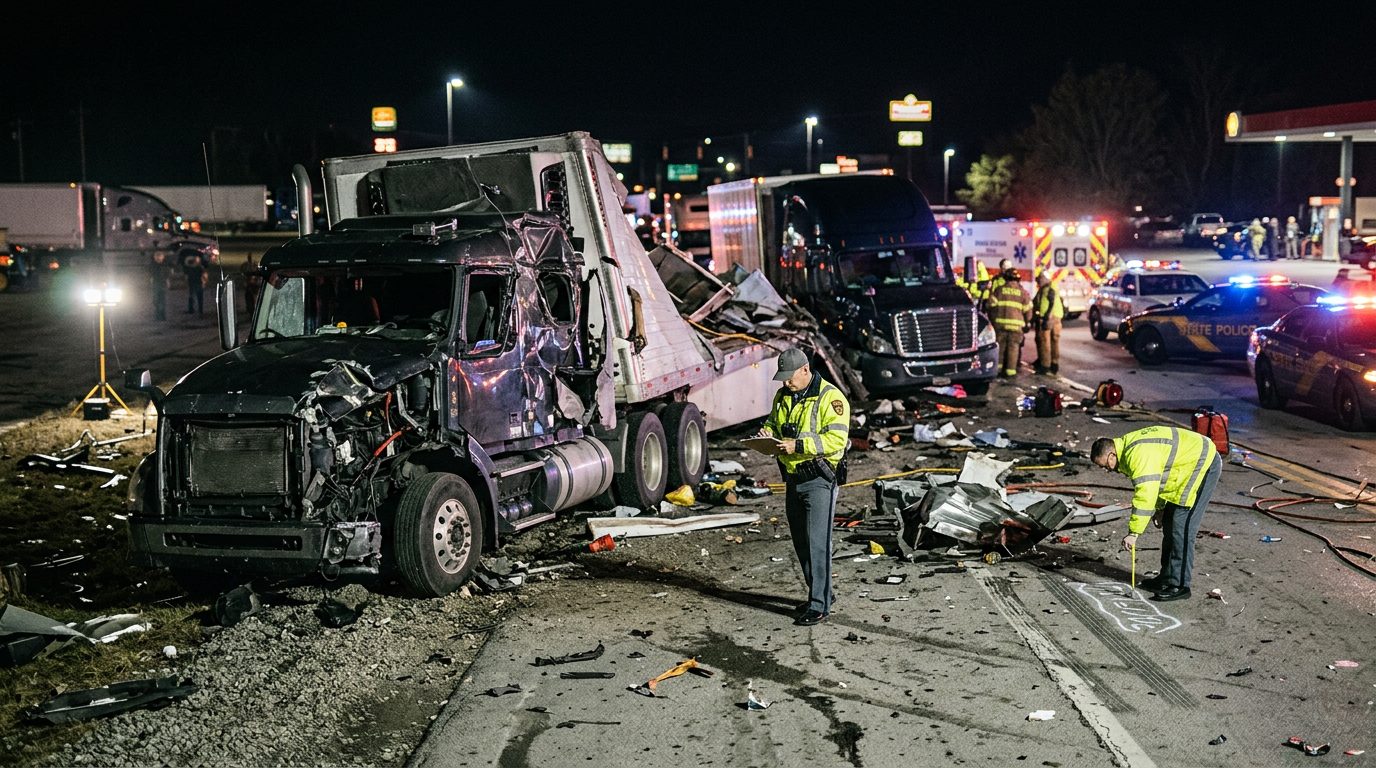
Scene and vehicle evidence shows where vehicles came to rest, how they moved, and how hard they hit. Scenes change quickly. Investigators try to document them early.
Physical marks matter most. Skid marks, debris fields, and final rest positions help place the vehicles in time and space. Road markings, weather, and lighting add more context. Damage patterns on each vehicle can show the angle and force of impact. Crash reconstruction work combines these clues.
Many commercial trucks have an electronic control module. This onboard computer can store engine and braking information from before a crash. If the truck is repaired or moved without preservation, that information can be lost.
Passenger vehicles often have an event data recorder. It can store similar pre-crash data. Families should ask early whether each vehicle still exists in its crash condition.
Which driver and trucking company records can show negligence?
Driver logs, qualification files, inspection reports, and testing records show what the driver and carrier did and knew. Each record follows its own rules.
Federal rules require carriers, except a private motor carrier of passengers (nonbusiness), to require each driver used by the motor carrier to record the driver’s duty status for each 24-hour period. 49 C.F.R. § 395.8 Carriers must keep these records for at least six months from the date of receipt. Logs can show whether a driver went past the allowed hours.
49 C.F.R. § 396.11 Brake and tire problems noted in these reports can matter.
49 C.F.R. § 382.303 If an alcohol test isn’t given within two hours, the employer must record why.
How do police reports, witness statements, and video support the case?
A police crash report records what the officer saw, measured, and heard. It usually includes diagrams, citations, and statements. It starts the timeline. It is one piece of evidence, not a final ruling on fault.
Witness accounts are most useful when taken early. Memories fade, and people move on. Each account can be checked against physical marks, vehicle damage, and the other records.
Video can show timing. Dashcam footage, traffic camera footage, and surveillance video from nearby businesses may show speed and lane position. Cell phone records can show whether a driver was using a phone during the crash. Video is often overwritten on a schedule, so early requests matter.
What medical, coroner, and toxicology records matter in a wrongful death case?
The coroner or medical examiner’s report records the cause and manner of death. Medical and hospital records show the injuries, the time of injury, and the care given.
Toxicology results matter for every driver involved. Alcohol and drug findings can be central to fault questions. W. Va. Code § 55-7-32 is one section of West Virginia law that addresses civil actions involving commercial motor vehicles.
Emergency response records show how quickly help arrived and what was done at the scene. Hospital records show when care began and which injuries were treated.
Medical findings also link the crash to the death. That link is the causation part of the case.
Not sure what your next step is?
Talk it through with Big Bubba — the first case review is free, confidential, and carries no obligation.
Who can be held liable, and how do trucking companies respond?
Several parties can share responsibility in a fatal truck crash. These may include the driver, the trucking company, the truck’s owner, and others tied to the truck. Which parties are named depends on the facts.
West Virginia generally makes each defendant liable only for its own percentage of fault. W. Va. Code § 55-7-13c A plaintiff’s fault does not bar recovery unless it is greater than the combined fault of all other persons responsible for the total amount of damages. Otherwise, the recovery is reduced. W. Va. Code § 55-7-13d The person who claims fault must prove it.
Federal law can also matter.
Defense arguments often point to the other driver, the person who died, road conditions, or a mechanical failure. Each argument is tested against the records. When logs, inspection reports, and scene evidence agree, the argument is easier to examine. When they don’t, the conflict itself becomes evidence.

Talking through a fatal truck crash with the firm
A free case review is a confidential first conversation about what happened and which records may still be available. It carries no obligation to continue.
You may be doing this research while grieving. Records may still be requested, and the details of the crash may remain unclear. That is a hard place to be.
The first decision is what to protect now. Truck data, driver logs, the police report, and any video can be lost or overwritten. Gathering what the family already has makes the next step clearer. That includes the crash report number, photos, the carrier and driver’s names if known, and medical paperwork.
If you are trying to protect the fatal truck crash negligence evidence for someone you lost, contact the firm to request a free case review.