
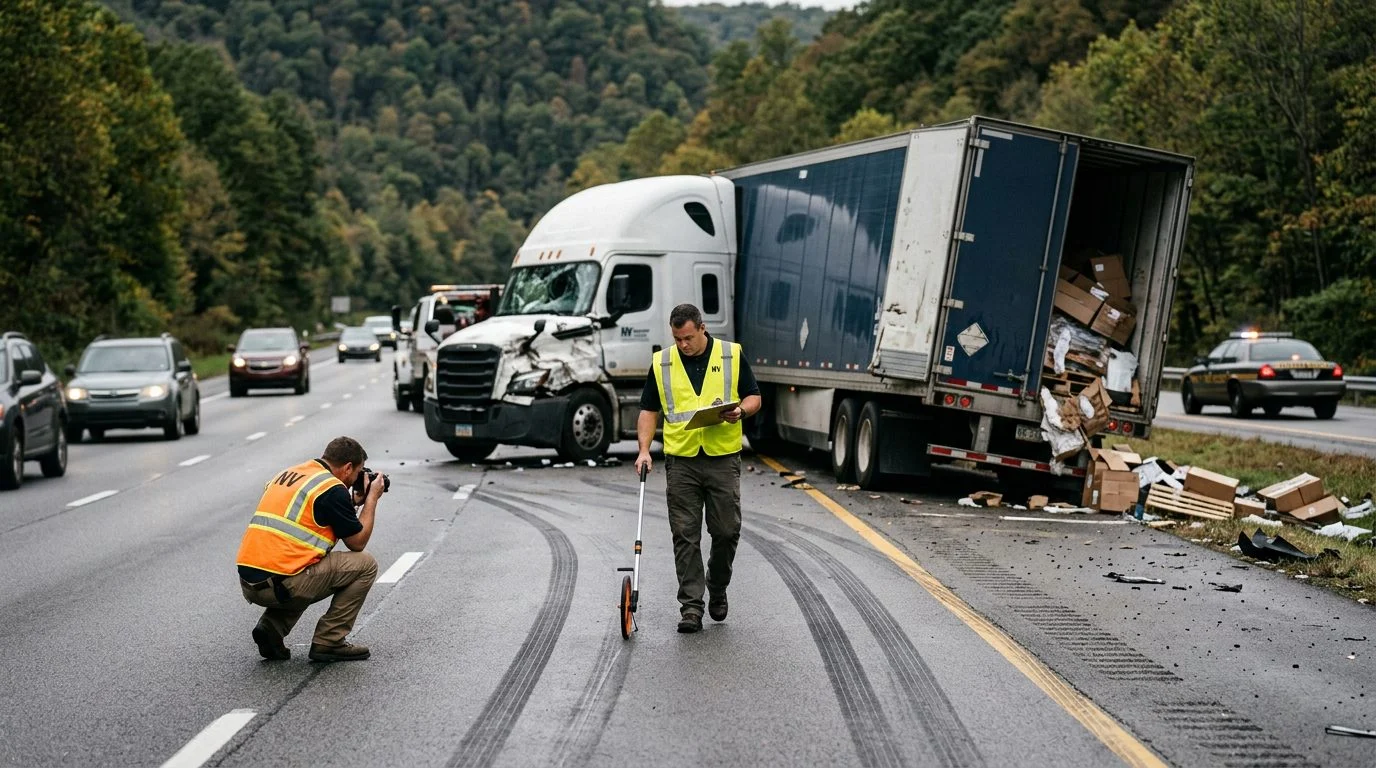
Truck Accident Claims in West Virginia
Hurt in a Truck Crash? Tell Big Bubba What Happened
Big Bubba represents people seriously injured in truck and commercial vehicle crashes, and families in wrongful death cases, across West Virginia. Reach out to the firm to talk through your situation.
Published November 6, 2026
A truck accident claim against trucking company West Virginia law allows is a request for money from the company and its insurer after a crash with a commercial truck. The trucking company may be liable, not just the driver. Deadlines are short and key records can be lost, so early steps matter. This guide explains who may be responsible, what evidence to protect, how the process usually moves, and how to handle the insurer. We handle truck accident claims and serve injured people across West Virginia, including Charleston, Huntington, and Morgantown.
What a Claim Against a Trucking Company Involves
A claim against a trucking company asks the company and its insurer to pay for losses caused by a crash with a commercial truck. It works differently from a claim against an ordinary driver because commercial carriers operate under federal and state rules.
Federal law also directs the government to set minimum insurance levels for many motor carriers, under 49 U.S.C. § 31139.
This type of claim may be brought by:
- Injured drivers and passengers
- Pedestrians and people in other vehicles
- Families of someone killed in a truck crash
In a fatal crash, the claim is generally brought by the estate’s personal representative. It generally must start within two years of the death (W. Va. Code § 55-7-6).
If an insurance adjuster for a trucking company has asked for a recorded statement after your crash, you can reach out for a free case review before you decide what to say. Talk it through with Big Bubba — the first case review is free, confidential, and carries no obligation.

Who May Be Responsible After a Commercial Truck Crash?
More than one party may be responsible, and the trucking company is often one of them, depending on the facts.
Under W. Va. Code § 55-7-32, an “employer defendant” can include the owner of a commercial motor vehicle, the driver’s employer, and any entity that holds legal control over the truck or driver.
Companies can also face claims over their own decisions. See McCormick v. W. Va. Dep’t of Pub. Safety.
Maintenance contractors or cargo loaders may also share fault in some crashes. Under W. Va. Code § 55-7-13c, each defendant is generally liable only for its own share of fault. A free case review is a good place to sort out each possible defendant.
Which Evidence Matters Early?
The evidence that matters most is often evidence that can disappear, so acting early helps.
Start with the basics: the police crash report, photos of the scene and vehicles, and names of witnesses. Write down what you remember while it is fresh.
Trucking companies must test drivers after some crashes, and those records have time limits. Under 49 C.F.R. § 382.303, an employer must test each surviving driver for alcohol as soon as practicable after certain accidents involving a commercial motor vehicle on a public road. Among the conditions listed, this applies where the driver receives a citation within 8 hours of the occurrence for a moving traffic violation arising from the accident and the accident involved bodily injury requiring immediate medical treatment away from the scene. If the test is not given within two hours, the employer must keep a record stating the reasons it was not promptly administered. Controlled substance testing must stop after 32 hours, and the employer must prepare and maintain on file a record stating the reasons the test was not promptly administered.
Retention rules also vary by record type. 49 C.F.R. § 382.401 sets minimum keeping periods, and some records need only be kept for one or two years. Under 49 C.F.R. § 379.3, companies must retain records for at least the minimum retention periods listed in appendix A to that part. Under 49 C.F.R. § 379.3, companies subject to the part must keep records for the minimum retention periods in appendix A to the part. After the required retention periods, the records may be destroyed at the discretion of each company’s management. The part does not excuse compliance with the lawful requirements of any other governmental body that prescribes longer retention periods for any category of records.
A written request asking the company to preserve driver logs, dispatch messages, and maintenance files can help. Medical records matter too. Some brain and spinal cord injuries may not be fully clear right away, so ongoing treatment notes can show the injury over time.
How the Claim Process Usually Unfolds
Most claims move through a free case review, an investigation, a demand to the insurer, and negotiation. A lawsuit is filed if the claim cannot be resolved that way.
- Free case review. You describe the crash, your injuries, and the parties involved. The firm looks at who may be responsible.
- Preservation letters. Written notice goes to the company and its insurer asking them to keep key records.
- Investigation. The firm may request records, medical documentation, and crash details.
- Demand. The claim and its supporting evidence go to the insurer in writing.
- Negotiation or lawsuit. Many claims are resolved through talks. Others may need a lawsuit in a West Virginia court.
On timing, W. Va. Code § 55-2-12 generally allows two years for personal injury claims, and exceptions may apply. Review the deadline early. Each case moves at its own pace, and no timeline can be promised.
Dealing With the Trucking Company’s Insurer
Slow down before you answer an adjuster’s questions. Some insurers may contact an injured person within days, often before the full medical picture is known.
A recorded statement may be used later, so understand what you are agreeing to before you give one. You can ask for time to review the facts and your injuries.
West Virginia law limits some early contact. Under W. Va. Code § 55-7-11a, for 20 days after an injury, a person may not negotiate a settlement of a claim for that injury while the injured person is an inpatient in any hospital or partially or totally unable to engage in his or her usual trade, profession or occupation. Under W. Va. Code § 55-7-11a, the injured person may disavow a settlement, release of liability or statement obtained in violation of that section within one hundred eighty days of the injury by signing a written statement of disavowal and sending a copy to the person who violated the section; for a settlement or release to be kept out of evidence, any money paid for it must be repaid or returned.
An early settlement offer may be worth reviewing before you accept. Signing a release may end your right to seek more, so read it carefully. Keep a written log of calls, bills, and missed work.
What a Claim May Cover
A claim may address medical bills, lost income, and pain and suffering. The losses that apply depend on the injury and the facts.
- Economic losses: medical care, rehabilitation, prescriptions, lost wages, and reduced ability to earn.
- Non-economic losses: pain, emotional distress, and loss of enjoyment of life.
- Catastrophic injuries: traumatic brain injury and spinal cord injury often need long-term care and can affect work and independence.
In a wrongful death case, W. Va. Code § 55-7-6 lets the jury award such damages as it may seem fair and just and direct how they are shared among survivors. These include sorrow, mental anguish, and solace, lost income and services of the person who died, care and treatment expenses, and reasonable funeral expenses.
For some commercial vehicle cases, W. Va. Code § 55-7-32 limits noneconomic damages against an employer defendant. The limit has conditions and exceptions, so it needs review in each case.
Not sure what your next step is?
Talk it through with Big Bubba — the first case review is free, confidential, and carries no obligation.
Common Questions About Truck Accident Claims
Here are short answers to questions people ask most often.
Can I still make a claim if I was partly at fault?
West Virginia generally reduces recovery by the injured person’s share of fault. Under § 55-7-13c, recovery is barred only if the injured person’s fault is greater than the combined fault of all others.
Do I have to file a lawsuit?
Many claims resolve with the insurer before a lawsuit. Some require one, depending on the facts.
Can the trucking company be named, not just the driver?
It may be, depending on the facts and the employer rules described above.
Should I speak with the insurer before I know my injuries?
It may be wise to limit statements until your injuries and the facts are clearer.
If an adjuster asked for a recorded statement after your truck crash, you can tell Bubba what happened and request a free case review. The firm will talk through the crash, the parties involved, and the next steps.