
Truck Accidents · West Virginia
Truck Accident Claims for Spouses in West Virginia
When a commercial truck crash injures your husband or wife, your whole household changes overnight. The firm represents people hurt in car and truck crashes across West Virginia and helps spouses understand their options.
Published November 3, 2026
Searching for a truck accident claim for spouse in West Virginia? A spouse may have a claim of their own after a truck crash, even if they were not in the truck. Whether that claim exists depends on the facts, the relationship, and what happened to the injured person. This page explains how these claims usually work, so you can see what may apply to your family.
What a Truck Accident Claim for Spouse Covers
Family members often have questions about how their own concerns relate to the injured person’s case, and the firm can discuss those questions during a free case review. It may cover losses that reach the whole household. Most spouses fall into one of three groups:
- Driver’s spouse. Your partner was driving a car or truck involved in the crash.
- Passenger’s spouse. Your partner was riding in a vehicle hit by a truck or another driver.
- Surviving spouse. Your partner died in the crash, and you are looking at a wrongful death claim.
Each group can lead to different claims and different deadlines. The firm handles car accidents, truck accidents, commercial vehicle accidents, catastrophic injuries, traumatic brain injury, spinal cord injury, and wrongful death. If your partner’s crash fits one of these, the firm can review it with you.
If your spouse was hurt in a truck crash, you may have rights of your own, and you don't have to sort them out alone. We're ready to talk through what may apply. Talk it through with Big Bubba — the first case review is free, confidential, and carries no obligation.

Claims a Spouse May Be Able to Bring
A spouse may be able to bring a loss of consortium claim, a claim for household losses, or a wrongful death claim. Which one applies depends on the facts.
West Virginia law recognizes these claims, and the loss of consortium statute is a starting point. Whether it fits your situation depends on the facts.
Household losses. When a spouse takes on driving, childcare, chores, or care at home, those losses may matter to the claim. Keep a simple record of what changed at home and who did the work.
That is the person formally appointed to handle the estate. See W. Va. Code § 55-7-6.
The injured person’s own losses. Wrongful death actions under W. Va. Code § 55-7-6 apply only after a death and are brought by the personal representative of the deceased person. Many couples plan these questions together. A free case review can help you see how they fit.
Who May Be Responsible in a Commercial Truck Crash
More than one party may share responsibility in a commercial truck crash. The driver is only one possibility. Other parties may include:
- the driver
- the motor carrier that employs the driver
- the owner of the truck or trailer
- a company that maintained or repaired the vehicle
- a company that loaded the cargo
West Virginia law defines an “employer defendant” to include the vehicle’s owner, the operator’s employer, and anyone holding legal control over the vehicle or operator. The statute also limits certain damages in some cases, and exceptions apply. Who is responsible depends on the facts, the trucking company’s records, and how the crash happened.
Evidence a Spouse Should Help Preserve
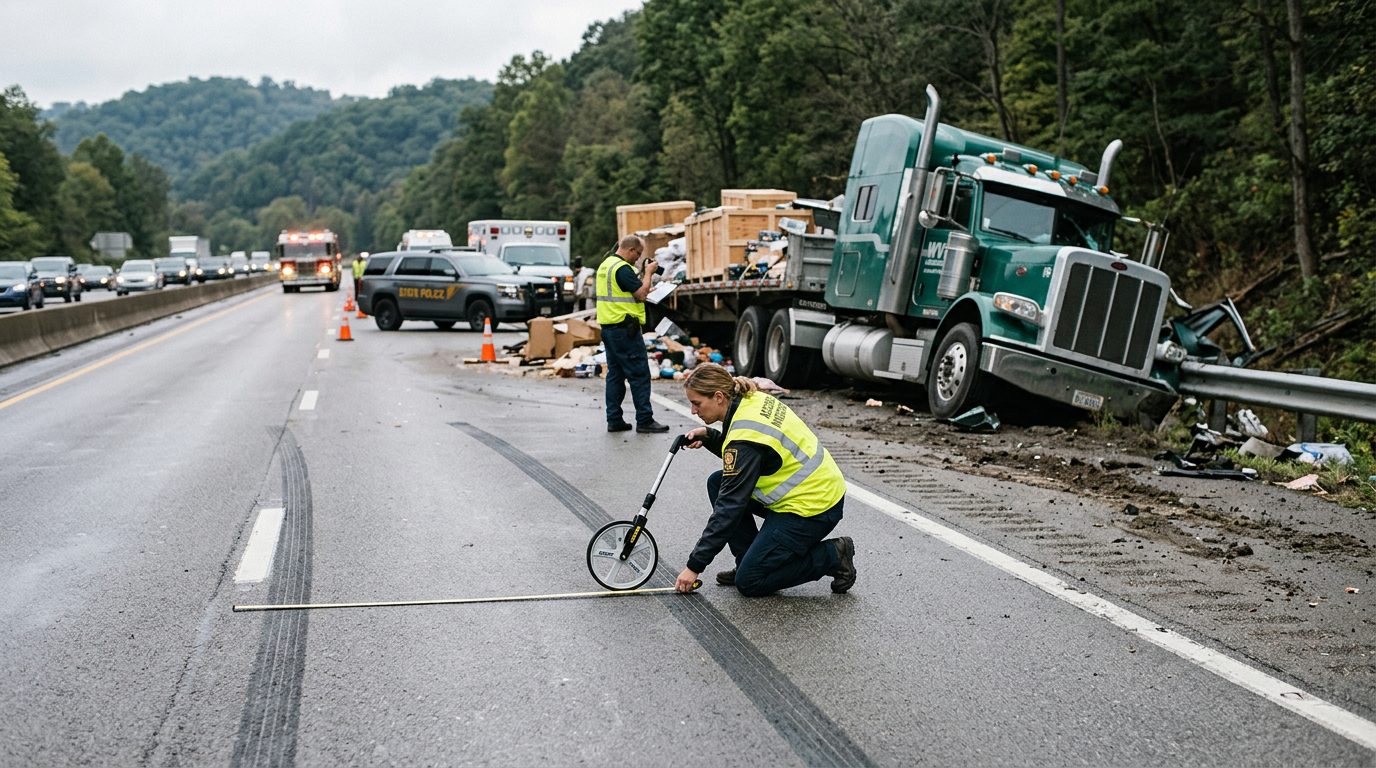
Early evidence often matters most. Start with the police report, photos, medical records, and the trucking company’s paperwork.
- Police crash report. It lists the parties, vehicles, and scene. Ask the investigating agency how to request a copy, since it may charge a fee set by that agency.
- Photos, video, and witnesses. Take pictures of the scene, the vehicles, and any injuries. Write down witness names and phone numbers.
- Medical records and a symptom journal. Keep bills, discharge papers, and a list of appointments and symptoms.
- Driver logs and inspection reports. Federal rules require motor carriers to have drivers record their duty status for each 24-hour period. See 49 C.F.R. § 395.8. Records of duty status and supporting documents must be kept for not less than 6 months from the date of receipt, under 49 C.F.R. § 395.8. See 49 C.F.R. § 396.21. Some records may be kept only for limited periods, so timing matters.
- Preservation letter. A letter to the responsible parties can ask them to keep relevant records. The firm can help decide when this step makes sense.
How a Truck Accident Claim Generally Moves Forward
A truck accident claim usually moves from first contact to investigation, evaluation, negotiation, and sometimes court. Each step depends on the facts, so no timeline fits every case.
- First contact and a free case review. You share the basic facts, and the firm explains what may apply. The free case review is confidential.
- Investigation. The firm looks at the police report, medical information, and records requests to the trucking side.
- Evaluation. The firm reviews the injuries and who may be responsible, based on what is known at that point.
- Negotiation. Some insurers may dispute a claim, so the firm may send a written demand.
- Court. If a fair resolution is not reached, a lawsuit may be filed. Court usually takes longer than negotiation.
Early insurer contact needs care. W. Va. Code § 55-7-11a says that during the first twenty days after an injury, while the injured person is a hospital inpatient or partially or totally unable to engage in his or her usual trade, profession or occupation, no one may negotiate a settlement, seek a release, or take a statement for that purpose. The statute lists limited exceptions. A spouse who gets an early call should know this rule exists.
Deadlines and Why Timing Matters
West Virginia generally allows two years to file a personal injury suit, and exceptions may apply. W. Va. Code § 55-2-12 sets this general limit, measured from when the right to sue arises.
For wrongful death, W. Va. Code § 55-7-6 says a claim generally must be brought within two years after the death, subject to other provisions of state law.
Waiting can make evidence harder to gather. Records may be lost, witnesses may move, and memories fade. A spouse may be busy with hospital visits and home life, so the firm can help you understand which deadlines may apply to your family.
Not sure what your next step is?
Talk it through with Big Bubba — the first case review is free, confidential, and carries no obligation.
Questions Spouses Often Ask
Common questions include a spouse’s own standing, timing, and what to bring. Short answers are below.
Can I bring a claim if I was not in the truck?
You may have your own claim in some cases, such as loss of consortium, depending on the facts.
What if my spouse is still in the hospital?
You can talk with the firm during treatment. The claim may be handled alongside medical care.
What should I bring to a free case review?
Bring the police report number, the crash date and location, provider names, photos, and any letters from insurers.
Does a police report decide who was at fault?
A police report may be one piece of evidence. It does not settle fault on its own.
Does my spouse have to contact the firm?
You can reach out for your injured partner. The firm can explain what it may need from them.

Information for Families After a Spouse’s Crash
If you are reading this while your partner is in treatment, you may feel worn out and full of questions. You don’t have to sort everything out at once. The firm can talk with you about how your situation fits these claims. When you’re ready, call the firm about your case, or tell Big Bubba what happened through the contact page and request a free case review. The review is confidential, and you can ask questions before you decide anything.