
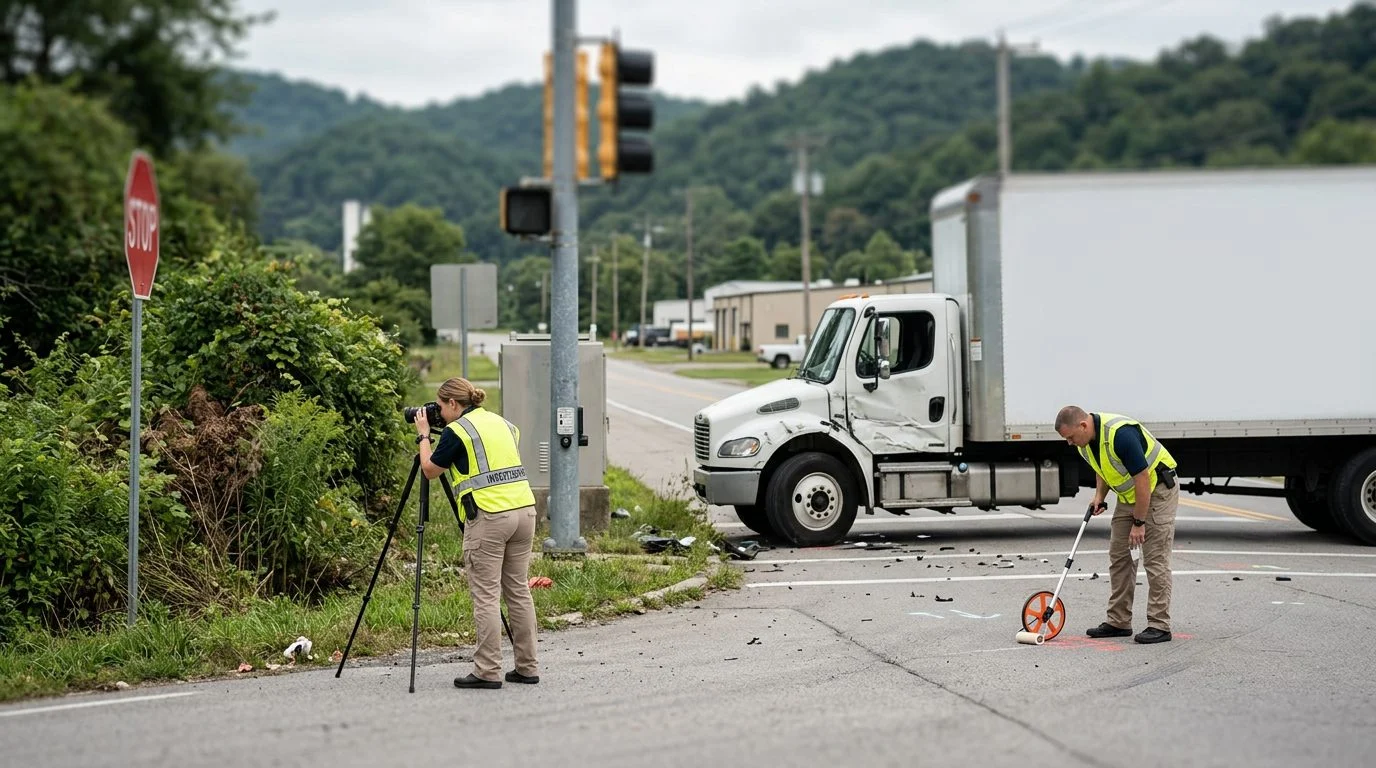
Wrongful Death | Truck Crashes | West Virginia
When a Truck Crash Takes a Family Member, You Deserve Answers
Our firm represents West Virginia families in wrongful death claims arising from commercial truck and vehicle crashes. Reach out to us to talk through what happened.
Published November 3, 2026
A wrongful death truck crash claim lets a family seek damages after a parent dies. This may be possible when another party’s wrongful act, neglect or default caused the death. Adult children often have a real stake, but the claim itself is usually brought by the parent’s personal representative. This guide explains the basics in plain language, so you know what to ask and what to gather first.
What a wrongful death claim after a truck crash is
A wrongful death claim is a case brought after someone dies because of another person’s wrongful act, neglect or default. W. Va. Code § 55-7-5 says the responsible person or company may be liable for damages even though the injured person has died.
Truck crashes often raise more questions than car crashes. A commercial truck may involve a driver, a trucking company, a truck owner, and sometimes others. Federal rules also require trucking companies to keep certain records, and those records can matter after a death.
Many adult children wonder whether they can take part at all. The claim is built around the losses the family suffered. The parent’s death is what started the claim, and the family’s losses are what the claim measures.
If your parent died in a truck crash and you are still deciding what to do, you can request a free case review with our team. Talk it through with Big Bubba — the first case review is free, confidential, and carries no obligation.

Who may bring the claim and who may recover
In West Virginia, a wrongful death action is generally brought by the personal representative of the person who died. W. Va. Code § 55-7-6 says the claim must be brought in the name of a duly appointed personal representative.
The personal representative is usually the person a court appoints to handle the estate. Confirming that appointment is one of the first practical steps. It can affect when the claim can move forward.
The same statute says the jury or the court decides how damages are shared. It names the surviving spouse and children, including adopted children and stepchildren, along with brothers, sisters, parents, and any persons who were financially dependent upon the decedent at the time of his or her death or would otherwise be equitably entitled to share in such distribution. Adult children are on that list. Whether a particular adult child receives a share depends on the family’s relationships and the losses claimed.
Siblings may have different roles. One may serve as personal representative while others share in the damages. The firm looks at each family’s facts on their own terms.
What a wrongful death claim may cover
A wrongful death claim may seek several kinds of damages. W. Va. Code § 55-7-6 lists these categories:
- Sorrow, mental anguish, and solace, which can include the parent’s companionship, comfort, guidance, and advice.
- Lost income and lost services, meaning the help, care, and support the parent would reasonably have provided.
- Care, treatment, and hospital costs tied to the injury that caused the death.
- Reasonable funeral expenses.
West Virginia has specific rules about how amounts are stated. A complaint in a personal injury or wrongful death case generally may not list a specific dollar amount of damages. See W. Va. Code § 55-7-25.
For some commercial vehicle crashes, W. Va. Code § 55-7-32 may limit certain noneconomic damages against an employer defendant. Exceptions apply, and any limit can depend on the facts and the employer’s insurance. No dollar figure can be predicted here, because every family’s losses are different.
Who may share responsibility in a commercial truck crash
More than one party may share responsibility in a truck crash, depending on the facts. The driver is one possibility. The company that employed the driver, the owner of the truck, and anyone who holds legal control of the vehicle may also be involved. W. Va. Code § 55-7-32 defines these as employer defendants.
Some claims also look at what a company did before the crash. Whether a claim like this applies depends on the facts of each case.
Fault is usually divided by percentage. Under W. Va. Code § 55-7-13c, a defendant is generally liable only for its own share of fault. Some conduct, such as driving under the influence, can lead to broader liability. Under W. Va. Code § 55-7-13d, the fault of people who contributed is considered even if they were never named in the suit, but fault of a nonparty is considered only if the plaintiff settled with that nonparty or a defending party gives notice no later than one hundred eighty days after service of process that the nonparty was wholly or partially at fault. Identifying every party early may matter.
Evidence that often matters in truck crash claims
The most useful records often come from the crash scene and from the trucking company. Start by collecting what the family already has.
- The police crash report, photos, and witness names.
- Hospital, emergency medical, and autopsy reports, when they exist.
- Funeral and burial receipts.
- The parent’s phone records, messages, and personal notes about the crash.
Trucking companies keep federal records. 49 C.F.R. § 395.8 requires motor carriers, except private motor carriers of passengers (nonbusiness), to have drivers record duty status for each 24-hour period. That record can be kept on an electronic logging device. The same rule bars tampering with that device so it does not accurately record data.
After a fatal crash, 49 C.F.R. § 382.303 requires the employer to test surviving drivers for alcohol and controlled substances in certain situations. If an alcohol test is not given within two hours, the employer must keep a record of the reasons.
Driver files also matter. 49 C.F.R. § 391.51 requires a motor carrier to keep a driver qualification file for each driver.
Some records may be kept for limited periods, so asking for them early may help. Review any statement from the trucking company or its insurer before you sign it.
How the process typically moves, step by step
Most claims move through investigation, negotiation, and, if needed, a lawsuit. The steps below show the usual order. Each stage depends on the facts and the parties involved.
- Gather records. Collect the crash report, medical and death records, and the parent’s employment and personal information. Identify who may serve as personal representative.
- Investigate. Request commercial vehicle records and send preservation letters to parties that may hold evidence.
- Assess. Review the losses and the liability evidence. The family stays informed as findings come in.
- Negotiate. Discuss the claim with the responsible parties and their insurers. Some insurers may dispute a claim.
- File if needed. If a fair resolution is not reached, a lawsuit may be filed in the proper West Virginia court.
Timing matters. W. Va. Code § 55-7-6 generally requires a wrongful death action to begin within two years after the death. Exceptions may apply, so timing deserves early attention.
Not sure what your next step is?
Talk it through with Big Bubba — the first case review is free, confidential, and carries no obligation.
Questions adult children ask about these claims
Adult children usually want to know whether they can take part and how the process starts. The answers below are short, and each depends on the facts.
Can an adult child be part of a wrongful death claim?
Often, yes. The law names adult children among the people who may share in damages. Whether a specific adult child may recover depends on the family’s facts and the statute.
Does the claim have to wait for probate?
The personal representative usually must be appointed first. That step can affect when the claim moves forward.
What if the parent was partly at fault?
Under West Virginia’s comparative fault rule, fault charged to the person who died does not bar recovery unless it is greater than the combined fault of others. Any recovery is then reduced in proportion to that fault. See W. Va. Code § 55-7-13c.
What if the insurer calls first?
Some insurers may dispute a claim or ask for a recorded statement. You can take your time before answering detailed questions.
Will the claim go to trial?
Many claims are resolved without a trial, though some go to trial. No outcome can be predicted at the start.
How the firm approaches these cases with adult children
The firm handles wrongful death claims, truck accident claims, and commercial vehicle accident claims for families across West Virginia. Adult children often coordinate siblings, relatives, and paperwork. The firm can explain each step to the family members who are involved.
The firm offers a free case review. It is a confidential first meeting with no obligation to continue. You describe what happened and share the papers you have.
To prepare, gather these items:
- The crash report number, if you have it.
- Your parent’s full name and date of death.
- Hospital, emergency, or funeral paperwork.
- The names of any companies or insurers that have contacted your family.
If your parent died in a truck crash and you are still deciding what to do, request a free case review. Tell the firm what happened and what papers you have. The firm will explain what it needs to review and what comes next. Request a free case review.