
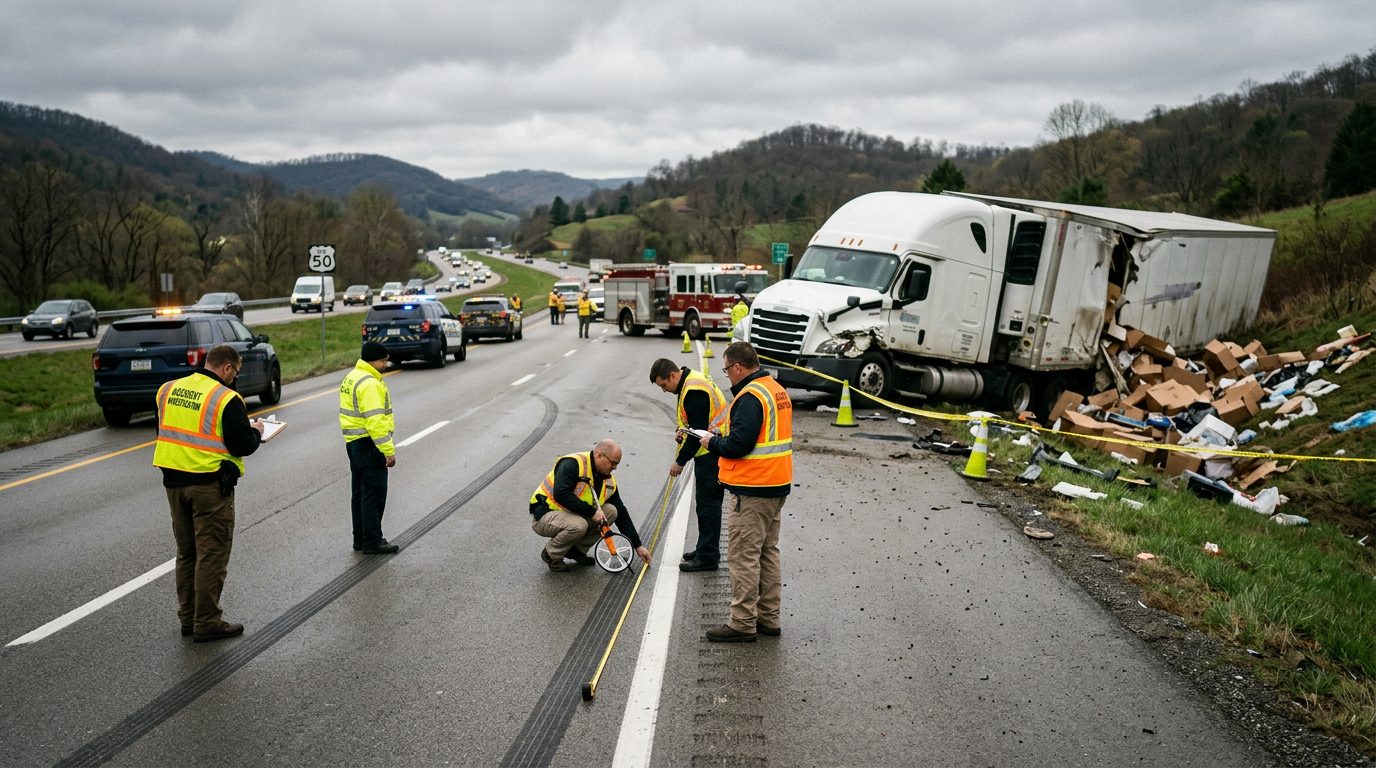
US 50 Truck Accidents | West Virginia
Hurt in a US 50 Truck Crash? Start With a Free Case Review.
Big Bubba Injury Law represents people hurt in car and commercial truck crashes along US 50 and across West Virginia, including families facing wrongful death. Talk with the firm about what happened, confidentially and with no obligation to continue.
Serving West Virginia
55
West Virginia counties served
Free
First case review
Confidential
Your conversation stays private
Published October 26, 2026
If you were hurt in a US 50 truck accident in West Virginia, you likely have many questions. A truck accident claim seeks money for losses the crash caused, such as medical bills and lost income. This guide explains what these claims cover, who may be responsible, what evidence matters, and what a free case review involves.
What a US 50 truck accident claim is and who it is for
A US 50 truck accident claim covers injuries or deaths caused by a commercial vehicle on U.S. Route 50 or a nearby road. A commercial vehicle can be a tractor-trailer, semi, box truck, or other large work vehicle.
These claims often involve injured drivers and passengers, pedestrians and motorcyclists struck by a truck, and families whose loved one died in a crash.
A truck crash often differs from a two-car collision. More companies may be involved, more records exist, and injuries are often more severe. Federal and state rules also apply to trucks and their drivers.
One crash can involve several claims. A survivor may have an injury claim while a family has a wrongful death claim from the same crash.
The firm handles car accidents, truck accidents, commercial vehicle accidents, catastrophic injuries, traumatic brain injury, spinal cord injury, and wrongful death. We serve people across West Virginia, including Clarksburg and Parkersburg.
If a truck on US 50 left you or someone you love hurt, you don't have to sort out the next steps alone, and the firm can talk it through with you. Talk it through with Big Bubba — the first case review is free, confidential, and carries no obligation.
Why crashes on US 50 can carry different risks
Heavy trucks on US 50 face the same road hazards as other drivers, but the stakes are higher. A loaded truck needs more distance to stop and more room to turn.
US 50 crosses north-central West Virginia. Local drivers, work traffic, and freight trucks often share the same lanes. In some sections, the road changes between two lanes and a divided highway, which can shift speed and lane use quickly.
Hills, curves, weather, construction zones, and lane shifts all add risk. A long downhill grade can strain a truck’s brakes, which is why the route’s terrain matters in many crashes.
These conditions do not decide any single crash. The facts of each crash, including the driver’s actions and the truck’s condition, shape what happened and why.
What a truck accident claim can cover
A truck accident claim can seek money for several kinds of losses. Each claim is different, and the value depends on the facts.
- Medical care: emergency treatment, hospital stays, surgery, rehabilitation, and medications.
- Future care: ongoing treatment, especially after a traumatic brain injury or spinal cord injury.
- Lost income: missed work now and lower earning ability later.
- Pain and suffering: physical pain and emotional harm, which look different in every case.
- Property: damage to a vehicle and personal belongings.
For a wrongful death case, W. Va. Code § 55-7-6 lists the damages a jury may consider. These include sorrow, mental anguish, and solace, reasonably expected loss of income and of services, protection, care and assistance provided by the decedent, care and treatment expenses incurred for the injury that caused the death, and reasonable funeral expenses.
For some commercial vehicle cases, state law limits noneconomic damages against an employer defendant to $5 million per occurrence. The limit does not apply if the employer lacks at least $3 million in commercial vehicle insurance. W. Va. Code § 55-7-32 also lists other exceptions.
Who may be responsible after a commercial vehicle crash
Several parties may share responsibility after a commercial vehicle crash. The driver is only one possibility.
- The driver: fatigue, distraction, speeding, or impairment may be examined.
- The motor carrier: hiring, training, supervision, and driver qualification may be examined.
- Maintenance providers: if brake or tire problems played a role.
- Cargo loaders or shippers: if cargo was unsecured or overloaded. The West Virginia Division of Motor Vehicles warns that unsecured cargo can cause serious crashes.
State law defines an “employer defendant” to include a truck’s owner, the driver’s employer, and others with legal control of the truck. Records about a driver’s hiring and background can be an important part of looking into how a truck crash happened. See the trucking company negligence guide for more detail.
If you were partly at fault, you may still recover. Under W. Va. Code § 55-7-13c, your fault only bars recovery if it is greater than the combined fault of everyone else. Otherwise, your recovery is reduced by your share.
Evidence that matters after a US 50 truck crash
After a US 50 truck accident in West Virginia, the evidence that disappears first is often the most useful. Early records make a difference.
- Police report: it lists the vehicles, drivers, and basic details of the crash.
- Photos and video: the scene, vehicle damage, road conditions, and debris.
- Witness details: names and phone numbers, gathered early.
- Medical records: a timeline that starts with the first emergency visit.
- Truck data: the engine control module and event data can show speed and braking. See the black box data guide.
- Driver logs and inspections: motor carriers must keep records of duty status for at least six months under 49 C.F.R. § 395.8. Driver vehicle inspection reports must be kept for three months under 49 C.F.R. § 396.11. The rules in this section shall not apply to a private motor carrier of passengers (nonbusiness), a driveaway-towaway operation, or any motor carrier operating only one commercial motor vehicle.
After certain serious crashes, federal rules require employers to test surviving drivers for alcohol and drugs. 49 C.F.R. § 382.303 sets out the triggers and timing. The FMCSA also explains federal testing rules.
How brake failure and runaway trucks change a case
When a truck loses braking control, the crash can look different from a typical collision. A truck that runs away on a downhill grade may strike several vehicles or leave the road.
Crash scenes can point to equipment trouble. Skid marks, debris patterns, and vehicle damage all help tell the story.
Maintenance history often becomes central. Repair orders, inspection reports, and brake service records show how the truck was kept. Equipment data can show speed and braking in the moments before impact.
Equipment questions are answered by the records that exist and the facts of each case. For more detail on these scenarios, read the runaway truck crash guide.
Not sure what your next step is?
Talk it through with Big Bubba — the first case review is free, confidential, and carries no obligation.
What to expect from a free case review
A free case review is a first step where you share what happened and the firm explains possible next steps. Here is how it usually works.
- Reach out: by phone or through the contact form. Share a short summary of when and where the crash happened on US 50 or a nearby road, and who was involved.
- Review the basics: the firm looks at your injuries, medical care, and any reports or photos you already have.
- Explain options: the firm describes the types of claims that may apply and what more information it would need.
- You decide: the free case review is confidential and carries no obligation to continue.
Timing matters. Under W. Va. Code § 55-2-12, the two-year period applies to personal injury claims for which no other limitation period is otherwise prescribed. Under W. Va. Code § 55-7-6, a wrongful death action generally must be commenced within two years after the death, subject to the provisions of section eighteen, article two, chapter fifty-five. W. Va. Code § 55-7-6 reads: “The provisions of this section shall not apply to actions brought for the death of any person occurring prior to July 1, 1988.”
State law also limits certain settlement talks in the first 20 days after an injury, when the injured person is in the hospital or cannot work. See W. Va. Code § 55-7-11a.
Bring your insurance information, the police report number, medical bills, and any letters from insurers or the trucking company.
Common questions about US 50 truck accident claims
What should I do right after a US 50 truck accident in West Virginia?
Get medical care first. Keep the police report number and photograph the scene if you can do so safely.
What if I was partly at fault?
West Virginia’s comparative fault rule can still allow recovery (W. Va. Code § 55-7-13c). If your fault is less than the combined fault of all other persons, your award is reduced in proportion to your degree of fault.
Can a family pursue a claim after a loved one dies in a truck crash?
Yes. A wrongful death claim is brought by the personal representative of the deceased person’s estate, within two years after the death, subject to the provisions of section eighteen, article two, chapter fifty-five (W. Va. Code § 55-7-6). W. Va. Code § 55-7-6 reads: “The provisions of this section shall not apply to actions brought for the death of any person occurring prior to July 1, 1988.”
Is a truck claim different from a car accident claim?
Yes. Commercial cases often involve more parties, federal trucking rules, and more detailed records.
How do I know if my injury is serious enough?
The firm can review your injuries and medical records during a free case review, so you get answers based on your own facts.
If you are deciding what to do next after a US 50 crash
You may be recovering from an injury yourself. You may be caring for someone who was hurt, or grieving a family member after a crash on US 50.
You do not need the legal answers before you reach out. Sharing what happened in your own words is enough to start.
Tell the firm what happened, and it can review whether your crash fits these claims in a free case review.
Related practice areas
- Truck Accident Claims in West Virginia | Big Bubba Legal
- Sue Trucking Company West Virginia: Crash Claim Guide