
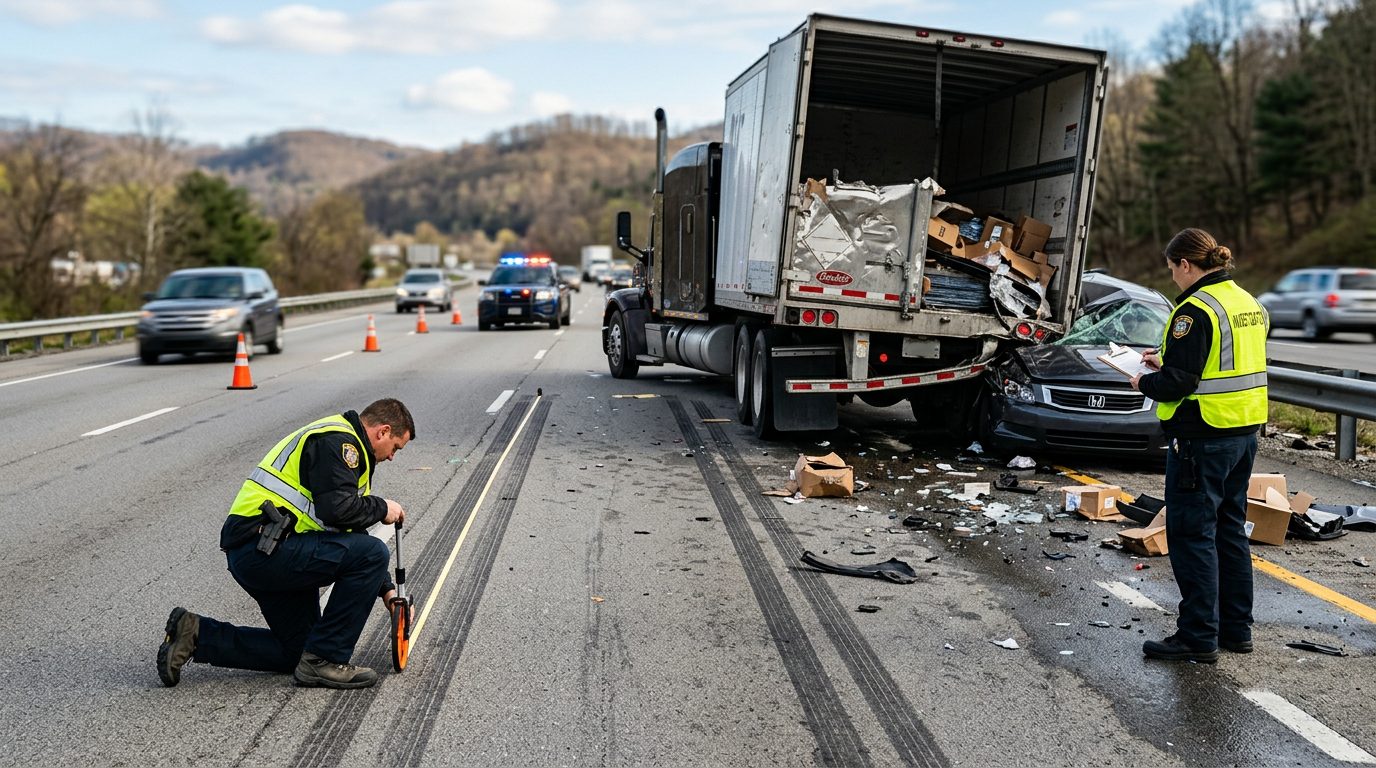
Truck Accident Claims | West Virginia
Hurt in an Underride Crash? Talk With Us About What Happened.
Underride collisions with large trucks can cause serious injuries and wrongful death. The firm represents people across West Virginia and the families they leave behind.
How the firm can help
Truck accident claims
We handle truck accident claims arising from collisions with tractor-trailers and other commercial vehicles.
Catastrophic injuries
We represent people with serious brain, spinal cord and other catastrophic injuries and the families who care for them.
Wrongful death
We help families who have lost a loved one in a crash and want to understand their options.
Across West Virginia
We serve injury victims throughout West Virginia, including Charleston, Huntington, Morgantown, Wheeling, Martinsburg, Parkersburg, Beckley, Clarksburg, Fairmont and Weirton.
Published November 3, 2026
An underride truck accident happens when a car or SUV slides under the rear or side of a truck trailer. These crashes can cause catastrophic injuries and wrongful death. If you were hurt or lost a family member, an underride truck accident lawyer in West Virginia can explain your options. We handle underride truck crash claims, and we serve injury victims across West Virginia, including Charleston, Huntington, and Morgantown.
What an Underride Truck Crash Is
An underride crash happens when a passenger vehicle slides under a truck trailer. The car’s windshield and roof often strike the trailer, which can cause severe harm to the people inside.
Trailers sit high off the ground. The driver may see only the side or back of the trailer before impact. In that moment, the trailer can be the only visible part of the truck.
Federal rules address rear guards. The federal standard at 49 C.F.R. § 571.224 establishes requirements for the installation of rear impact guards on trailers and semitrailers with a gross vehicle weight rating (GVWR) of 4,536 kg or more. Its stated purpose is to reduce deaths and serious injuries when light duty vehicles strike the rear of those trailers (rear impact protection rules). Under 49 C.F.R. § 393.86, each trailer and semitrailer with a gross vehicle weight rating of 4,536 kg (10,000 pounds) or more, and manufactured on or after January 26, 1998, generally must have a rear impact guard. The vertical distance between the bottom edge of the guard’s horizontal member and the ground shall not exceed 560 mm (22 inches) at any point across the full width of the member. Certain vehicles are excluded, such as pole trailers and low chassis vehicles (rear impact guard requirements).
Side crashes raise separate questions and may involve other rules. This page is for drivers and passengers in cars and SUVs, and for families of people killed in these crashes.
If a car or SUV went under a trailer and you or a loved one was hurt, you may have a claim worth reviewing. Request a free case review and tell Big Bubba what happened. Talk it through with Big Bubba — the first case review is free, confidential, and carries no obligation.

Why Underride Crashes Often Cause Catastrophic Injuries
Underride crashes can cause catastrophic injuries because the passenger area may strike the trailer directly. Head, neck, and spinal injuries are among the main concerns in these crashes.
The firm handles catastrophic injury claims, including traumatic brain injury and spinal cord injury cases. Each injury affects each person differently. Recovery looks different from one person to the next.
Some injuries are not clear right after a crash. Symptoms may appear later. A medical check-up soon after the crash can matter for your health and for the record. Keep a daily written note of pain, numbness, memory problems, and sleep trouble.
Medical records made early can matter to a claim. Keep every bill, discharge paper, and appointment note.
What an Underride Truck Crash Claim May Cover
A claim may cover medical costs, lost income, and other losses. Each category needs proof.
- Medical care already received, and care treating providers say may be needed later
- Lost wages and reduced ability to earn
- Pain, suffering, and loss of enjoyment of life, which are assessed case by case
- Damage to the vehicle and personal property
For a fatal crash, West Virginia’s wrongful death statute sets out the claim. A personal representative brings the action for the family. The jury’s verdict shall include, but may not be limited to, damages for sorrow, mental anguish, and solace, including loss of companionship and guidance. The verdict must include, but may not be limited to, compensation for expected loss of income and services, expenses for care, treatment and hospitalization incident to the injury resulting in death, and reasonable funeral expenses (W. Va. Code § 55-7-6).
Who May Be Responsible
Responsibility is decided case by case, and more than one party may be involved. Possible parties include the driver, the motor carrier, the trailer owner, a repair or maintenance provider, and a guard maker.
Federal rules require motor carriers to systematically inspect, repair, and maintain the motor vehicles they control. Those duties cover parts that affect safety, such as frames, axles, and steering systems (inspection and maintenance rules). A claim may look at whether those duties were followed.
West Virginia defines an “employer defendant” in commercial vehicle cases. The term can include the vehicle’s owner, the operator’s employer, and anyone who holds legal control over the truck or driver (W. Va. Code § 55-7-32). That definition can matter when a carrier, not only a driver, is involved.
Some insurers may dispute a claim or question how the crash happened. Early documentation can help answer those questions.
Evidence That Can Matter Early
The most useful evidence is often the evidence that disappears first. Start preserving it as soon as it is safe to do so.
- The police crash report. Ask the reporting agency how to get a copy. Agencies may set their own copy fees.
- Photos and video. Capture the scene, the trailer, the guard, and your vehicle.
- Witness details and dashcam footage. Get names and phone numbers as soon as you can.
- Truck maintenance and inspection records. Federal rules require these records to be kept for 1 year where the vehicle is housed or maintained, and for 6 months after it leaves the carrier’s control (inspection and maintenance rules).
- Driver duty status records. Carriers must keep these for not less than 6 months from the date of receipt (driver duty status rules). Electronic logging device data may also be relevant where it exists.
- Your own records. Keep medical bills, a symptom log, and notes on missed work.
Because some records are kept only for limited periods, early requests to the trucking company may be relevant.
How a West Virginia Underride Claim Typically Moves Forward
You can start with a free case review. From there, the claim moves through investigation, presentation, and either settlement talks or a lawsuit. The path varies from case to case.
- Free case review. You share what happened. The free case review is offered with no obligation to continue.
- Investigation. The firm may gather crash reports, scene evidence, carrier records, and medical documentation.
- Claim presentation. The responsible parties and their insurers may be notified, and a claim may be presented.
- Negotiation or filing. Some claims may resolve without a lawsuit, depending on the facts of each case. Some require filing.
Timelines vary with injury severity, the number of parties, and access to records. No fixed schedule applies to every claim.
Deadlines matter. West Virginia generally allows two years to bring a personal injury action, and exceptions may apply (W. Va. Code § 55-2-12). A wrongful death action generally must be commenced within two years after the death (W. Va. Code § 55-7-6). W. Va. Code § 55-7-6 reads: “The provisions of this section shall not apply to actions brought for the death of any person occurring prior to July 1, 1988.” Contact the firm early so deadlines can be reviewed.
Not sure what your next step is?
Talk it through with Big Bubba — the first case review is free, confidential, and carries no obligation.
Frequently Asked Questions About Underride Truck Crash Claims in West Virginia
What makes an underride crash different from other truck accidents?
The passenger vehicle strikes the underside or rear of the trailer. That can change how injuries happen and how the crash is reviewed.
Can a family bring a claim after a loved one dies?
West Virginia law sets out who may bring a wrongful death action and how damages may be shared. A review of the family’s situation is the best next step.
Do I need a police report?
A report is often useful and may be relevant to the claim. You can reach out to the firm even if you do not have one yet.
How soon should I reach out?
Early contact can help preserve evidence and review deadlines. Timing may be relevant to your situation.
Can an insurance adjuster ask for a recorded statement?
Some insurers may ask for one. You may choose how you respond, and talking with the firm first can help you understand your options.
Your Options After an Underride Crash
If a car or SUV went under a trailer and you or someone you love was hurt or killed, you do not have to sort out the next steps alone. Request a free case review with the firm, and tell Big Bubba what happened in your own words. We serve injury victims across West Virginia.