
Multi-Vehicle Crashes | West Virginia
When Three or More Vehicles Are Involved, Fault Can Get Complicated
Understanding a chain-reaction crash report is a first step. We help families in West Virginia sort out what happened and who may be responsible.
Published November 14, 2026
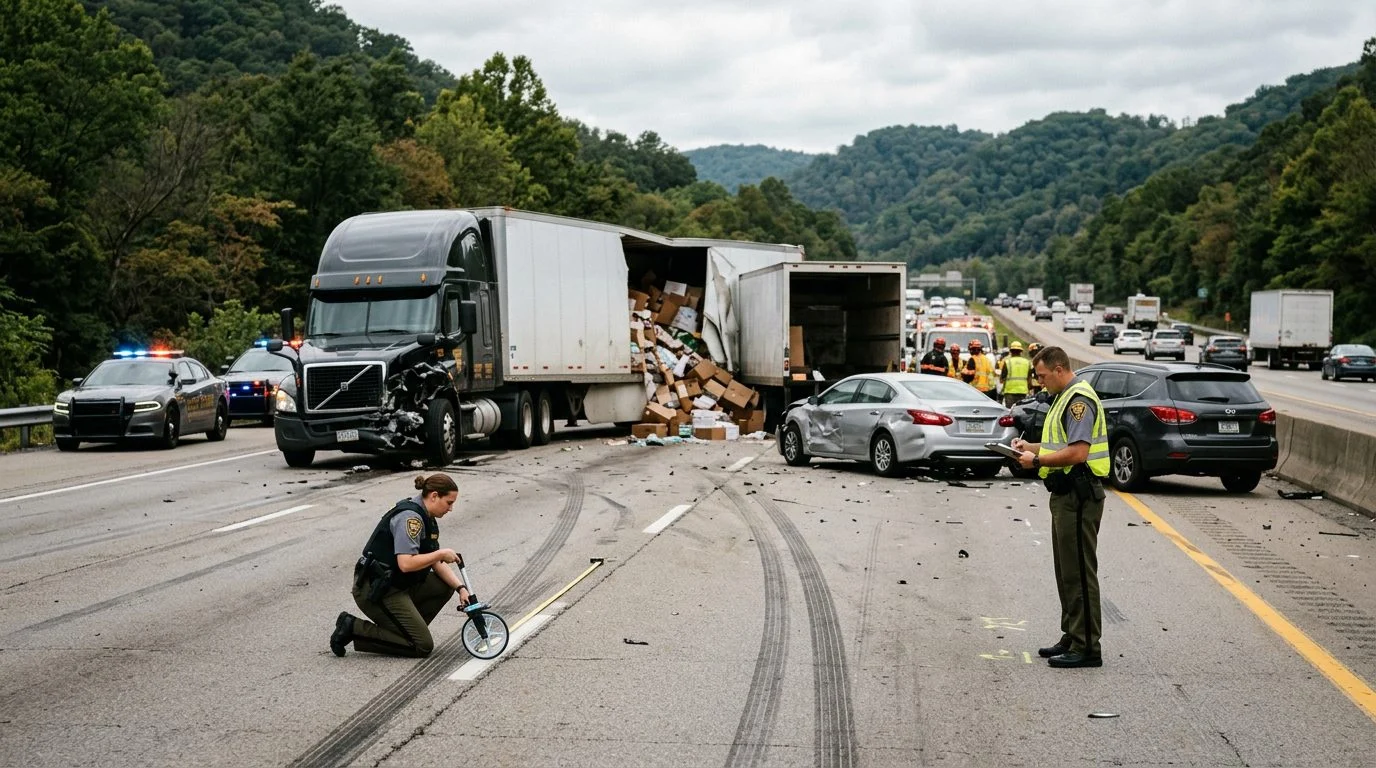
If you are reading a crash report that lists three or more cars, you may be trying to understand what it means for someone you love. A multi-vehicle accident is a single crash event involving three or more vehicles. It often happens as a chain reaction, when one impact pushes cars into others.
The label matters because it can change who is involved and how fault gets sorted out. This page explains what the term covers in West Virginia, how fault is divided, and what evidence often matters.
What is considered a multi-vehicle accident?
Three or more vehicles that are part of one collision sequence make up a multi-vehicle accident. The key idea is the sequence. Vehicles must be part of the same collision, not just parked along the same road or nearby on the highway. Cars that stopped or drove past without taking part usually do not make a crash multi-vehicle.
Separate impacts can still count as one event. If one crash leads to a second and third impact within seconds or minutes, police and insurers may describe it as a single multi-vehicle event. How they describe it depends on the scene and what investigators find.
Labels can differ between documents. A police crash report may call the event a chain-reaction collision, while an insurance claim may use different words. Read the narrative and diagram sections of the report closely, since they often show the order of impacts. That order can matter later when investigators look at which collision caused which injury.
If a crash with several vehicles left someone you love hurt, you don't have to work out the fault questions alone, so reach out for a free case review. Talk it through with Big Bubba — the first case review is free, confidential, and carries no obligation.

Common types of multi-vehicle crashes
The most common types are chain-reaction collisions, highway pileups, intersection crashes, and crashes that involve a commercial vehicle. Each type raises its own questions about how the crash began and who had a chance to stop.
A chain-reaction collision happens when one impact pushes vehicles into the ones ahead or behind them. A driver who stops suddenly, or who is struck from behind, can trigger a string of impacts within seconds.
Highway pileups often form when traffic slows quickly, or when fog, rain, or smoke cuts visibility. In these crashes, the first impact may be hard to see from behind, and more cars can join before drivers can stop.
Intersection crashes can involve several drivers after one signal or right-of-way dispute. A car that runs a red light may hit a vehicle, which then spins into a third.
Crashes with a commercial truck, bus, or other commercial vehicle deserve extra attention. These vehicles are larger and usually carry more records, which can matter later in the claim.
How a multi-vehicle crash differs from a two-car collision
A two-car collision usually involves two drivers and two insurers, while a multi-vehicle crash can involve many more. Each added vehicle can bring another driver, a vehicle owner, passengers, and an insurer into the picture. Some of those people may have injury claims, and some may have defenses of their own.
More impacts can also make it harder to tell which collision caused which injury. A driver may be hurt in the first impact, then hit again by a second car. Medical records and scene evidence help sort out the timing.
Many people ask what happens when two cars hit each other. In a two-car crash, fault is usually sorted out by looking at each driver’s conduct and the facts of the crash. The same basic approach applies when more vehicles are involved, but there are more conduct questions to answer. A multi-vehicle claim can take more steps to organize, because each driver’s account has to be compared with the others.
Who may be involved and who may be responsible
Drivers, passengers, vehicle owners, and employers may all be part of a multi-vehicle claim. When a commercial driver was working at the time, the employer may be part of the claim. West Virginia law defines an “employer defendant” in commercial vehicle cases to include the vehicle’s owner, the driver’s employer, and certain others who control the vehicle. W. Va. Code § 55-7-32 sets out that definition.
Other parties can also be relevant in some cases, such as a company that leased the vehicle or one that maintained it. If another driver was at fault, that driver’s insurer may be part of the claim.
West Virginia law also allows a person to be held liable for fault assigned to an agent or servant acting for that person. See W. Va. Code § 55-7-13d for how the state handles that question.
Early in the claim, timing rules also apply. Under W. Va. Code § 55-7-11a, no one may negotiate a settlement with an injured person within twenty days of the injury while that person is in the hospital or unable to work, with some exceptions.
How fault is divided in a multi-vehicle crash
West Virginia generally divides fault by percentage among everyone who contributed to the harm. Under W. Va. Code § 55-7-13a, each person’s liability is allocated in direct proportion to that person’s percentage of fault, including nonparties who caused the harm.
Your own share of fault does not automatically stop a claim. Under W. Va. Code § 55-7-13c, an injured person’s fault does not bar recovery unless it is greater than the combined fault of all other persons responsible. When it is less, recovery is reduced in proportion to the injured person’s share.
Nonparties can matter too. Under W. Va. Code § 55-7-13d, the trier of fact shall consider the fault of all persons who contributed to the alleged damages, regardless of whether the person was or could have been named as a party to the suit. Fault of a nonparty shall be considered if the plaintiff entered into a settlement agreement with the nonparty or if a defending party gives notice no later than one hundred eighty days after service of process upon that defendant that a nonparty was wholly or partially at fault, and the statute sets further conditions on how that fault is assessed.
Each defendant generally answers only for its own share of fault. Joint liability applies in limited cases, such as certain drunk-driving or criminal conduct, under W. Va. Code § 55-7-13c.
A settlement with one party does not automatically end claims against others. Under W. Va. Code § 55-7-12, a release of one joint tort-feasor (a party who shares blame for the same harm) does not bar an action against another for the same cause of action.
Injuries that are common in multi-vehicle crashes
Multi-vehicle crashes can cause serious head, neck, and back injuries, including traumatic brain injury and spinal cord injury. In a multi-vehicle crash, the body can be hit more than once, which can make the source of each injury harder to sort out.
Trauma such as a car accident can cause a spinal cord injury, according to the Christopher & Dana Reeve Foundation. The same fact sheet notes that the level and severity of an injury affect function and walking.
The VA traumatic brain injury overview lists motor vehicle accidents among common causes of traumatic brain injury. Some symptoms may not appear right away, so a medical evaluation is commonly recommended after any crash.
Recovery depends on the person and on the medical findings. Keep a written list of symptoms and every doctor visit, starting the day of the crash. That list can help your medical team and anyone reviewing the claim. We handle catastrophic injury, traumatic brain injury, and spinal cord injury claims.
Not sure what your next step is?
Talk it through with Big Bubba — the first case review is free, confidential, and carries no obligation.
Records and evidence that often matter after a multi-vehicle crash
The crash report, photos, witness details, and medical records are usually the first items to gather. The police report may list each vehicle, each driver, and any reported contributing factors. Photos and scene diagrams can show where each vehicle stopped, which helps explain the order of impacts.
If a commercial vehicle is involved, the timing of testing and the carrier’s records may matter. Under 49 C.F.R. § 382.303, an employer must test surviving drivers for alcohol as soon as practicable after certain commercial vehicle crashes. When a death is involved, this covers drivers who were performing safety-sensitive functions. When the crash involves an injury that needs immediate treatment away from the scene, or a vehicle that has to be towed away, the test applies if the driver receives a citation for a moving traffic violation within 8 hours of the crash. If an alcohol test is not given within two hours, the employer must keep a record of why.
Some trucking records come from electronic logging devices.
Maintenance records are also important. Under 49 C.F.R. § 396.3, carriers keep inspection and repair records. Those records must be kept for one year where the vehicle is housed or maintained, and for six months after the vehicle leaves the carrier’s control. These records may be relevant to a multi-vehicle claim.

Talking through a crash with several vehicles
The firm handles car, truck, and commercial vehicle accident claims, along with catastrophic injury and wrongful death cases. You may be reading this while caring for someone in a hospital bed, or while still trying to understand a crash you did not choose.
We serve injury victims across West Virginia, including people in Charleston, Huntington, Morgantown, Wheeling, Martinsburg, Parkersburg, Beckley, Clarksburg, Fairmont, and Weirton. When you reach out, it helps to have the crash report number, the names of the drivers, and your medical paperwork nearby, even if some of it is incomplete.
If a crash with several vehicles left someone you love hurt, you don’t have to work out the fault questions alone, so reach out for a free case review.